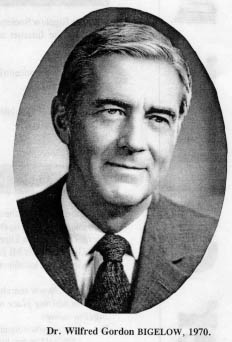
4 Children of Wilfred and Ruth (Jennings) Bigelow:
1592C.16531 John, b _____ ; d _____ ;
1592C.16532 Dan, b _____ ; d _____ ;
1592C.16533 Bill, b _____ ; d _____ ;
1592C.16534 Pixie, b _____ ; d _____ ; m Ian
Currie.
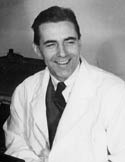
earlier photo of "Bill"
Video
Honoring Dr. Bigelow
Sources:
Bigelow Society,The Bigelow Family Genealogy, Vol II, pg
426;
Howe, Bigelow Family of America;
Note 06/26/06:
From: Peter Flood < pflood@torontohydro.com >
Rod:
I have been trying  to contact Dr. Bigelow for a while now. My efforts - even through the College of Physicians & Surgeons - have proved fruitless.
I met him twice many years ago(1963 & 1969 ??) 1st @ the wedding of Marion Turner to Peck Turner & then at the dinner party given by Marion & Peck for their friends which included Dr. Bigelow & myself. Medicine was even discussed but he had so many other interests & things to say. Peck died in 1977 & Marion several years  ago after she had married for second time Hugh ? Perry in 1988.
Peter Flood
http://www.hrsonline.org/ep-history/notable_figures/bios/wilfred_bigelow/
| Subject: | dad-thought you might want to read this |
|---|---|
| Date: | Tue, 29 Mar 2005 07:41:14 -0800 (PST) |
| From: | Matt Bigelow <biggs44_13@yahoo.com> |
From: Toronto Globe and Mail, sent by Larry Baxter 03/30/05
| WILFRED GORDON BIGELOW After a life lived with caring, intellectual curiosity and a profound sense of spirituality, Bill died peacefully in Toronto on Easter Sunday 2005. Born in Brandon, Manitoba, Bill was the son of Dr. Wilfred Bigelow, founder of the first medical clinic in Canada, and Grace Gordon, nurse and midwife. He was raised in an environment that encouraged a love of family, nature, music and education. Bill attended Brandon College in the early 1930's and graduated from medicine at the University of Toronto in 1938. Following this, he ser ved overseas as a Captain in the Royal Canadian Medical Army Corps, performing battle surgery on the frontlines. Returning home from the war, he furthered his studies at John Hopkins in Baltimore, Mar yland specializing in cardiac surgery. His experiences in the war with amputations due to frostbite led him to explore the principle of hypothermia. He felt strongly that to make progress in cardiac surgery, surgeons needed to open the heart and operate directly. Building on his wartime experiences, he theorized that if you could cool the heart, you could reduce oxygen requirements, inter r upt circulation and open the heart. In 1947, Bill retur ned to Toronto, and established a hypothermia research unit at The Banting Institute. There, he performed the world's first open heart surgery on a dog using the principal of hypothermia, paving the way for its use on humans. At his lab, Dr. Bigelow and his colleagues Dr. John Callaghan and Dr. John Hopps also developed the cardiac pacemaker. Bill was recognized internationally as the father of Canadian heart surgery. He received the Gairdner Foundation Award in 1959, was inducted into the Canadian Medical Association's Hall of Fame in 1997 and into the Order of Canada in 1981. Bill published numerous medical articles in scientific journals, educated aspiring cardiac surgeons from around the world, and authored two books, Cold Hearts and Mysterious Heparin. Along with his passion for medicine, Bill will be remembered for his love of the outdoors and his work on environmental causes. He ser ved as a director of the Audubon Society and the Nature Conser vancy of Canada. He spent many happy hours on the islands of Georgian Bay, and at his farm in Collingwood with his beloved family, horses and dogs. He was an avid bird watcher who went on frequent field trips with his longtime friend Dr. Br uce Charles. In his latter years, he enjoyed many happy hours with his golf buddies at the Toronto Hunt Club. First and foremost, Bill was a family man and a devoted and loyal friend to many. He was predeceased by his beloved wife of almost 60 years, Ruth Jennings, who attracted his attention as a caring and efficient operating nurse at Toronto General Hospital. He was also predeceased by his infant brother Jack, and his sisters Mary Grant (Millard), and Toody McKinnon (Keith). He is survived by his brother Dr. Dan Bigelow and his wife Dr. Sonia Saceda. As a loving father and grandfather, Bill led by example, demonstrating the importance of loyalty and the power of positive thinking and perseverance. He will be deeply missed by his daughter Pixie Bigelow Currie (Ian) of Toronto, and sons, John (Ellie) of Honolulu, Hawaii, Dan (Blanche) of Petersfield, Manitoba, and Bill of Toronto. He is remembered with affection by his grandchildren Scott Currie (Sarah), Susanne Coutts (Rob), Mathew Bigelow, and Angela Beatton (Don) and his nieces, nephews and their families. Bill adored children and was delighted with the birth of his three great grandchildren, Sophie and Chloe Coutts and Stella Currie. The family recognizes with gratitude his caregivers Alma Ablona, Beth Lara and Helen Ablona and the staff of Belmont House. The funeral and interment will be private. A memorial service will be held at Rosedale United Church on Saturday, April 23, 2005 at 2:00 p.m. Donations in his memory may be made to establish The Bigelow Lectureship, Department of Surgery, University of Toronto, The Banting Institute, 100 College Street, Room 311, Toronto, Ontario, M5G 1L5, telephone (416) 978-5148; or to continue The Bigelow Book Prize, Cardiovascular Sciences Collaborative Program, 150 College Street, Room 83D, Toronto, Ontario, M5S 3E2, telephone (416) 978-7744. |
http://www.partnersoftheheart.com/break/heart3.html
correspondence with family descendant and Bigelow Society
historian/genealogist.
Forge Oct 1997, Vol. 26, No. 4, page 68.
Newspaper clippings submitted by Reid Bigelow, Winnipeg MB and
Dorothy Hoffman, St. Catharines, ON.
Thanks to Dr. Bill Bigelow for supplying the photograph and
further information.
Related articles in Forge: Vol. 25, No. 2, April 1996. Vol.
25, No. 2 (April 1996).
Also Forge article on Wilfred Gordon: Wilfred
Gordon
October 1997 FORGE: The Bigelow Society Quarterly Vol. 26, No. 4 Page 68
The decades
following World War II produced Phenomenal advances in the
diagnosis and treatment of disease, but none were more
spectacular than the development of cardiac surgery. Indeed,
the years between 1950 and 1990 have been called the golden
age
of cardiology. Canadians were in the forefront, led by Dr.
Wilfred Gordon "Bill" Bigelow (1592C.1653), an innovative
surgeon-scientist at Toronto General
Hospital.
His pivotal role in hypothermia research and in developing the
cardiac pacemaker were recognized in February of this year
when he was named to the Canadian Medical Hall of Fame.
"I was surprised," Bigelow said, adding he hadn't expected to
be named since awardees can be selected from the entire sweep
of Canadian medical history.
It was through an idea that came to him in his sleep that Dr.
Bigelow made medical history, by chilling patients during
heart surgery - a move every other doctor thought would kill
them.
He had developed an interest in hypothermia as a resident
surgeon after having to amputate the frost-bitten fingers of a
young man. During the
time he served with the Canadian Army in World War H, he again
thought of
hypothermia as a way to save limbs in which the main artery
had been severed.
"I was interested in cooling limbs to see if you could protect
them," he said. "One day I woke up and thought why not cool
the whole body."
Plunging the body into hypothennia delays deterioration of
tissue when a patient's circulation has been stopped, which
allowed surgeons in the 1950s to perform the first heart
operations.
It was a landmark discovery that left the profession
speechless when
Bigelow presented his findings before the American Surgical
Association
in Colorado in 1950.
"When we presented the paper there was no discussion," said
Bigelow,
83, retired head of thenToronto General Hospital's division of
cardiac surgery.
"It was one of the very few basic medical discoveries where no
one stood up to say they'd done something similar."
After 5 years of research on the effects of hypothermia on
body and heart metabolism, the first open heart operation in
humans was performed in
1953. It was soon widely used throughout the world and is
still used today
in modified forms.
Another crucial observation arose from these studies. One
morning in
1949, during an experiment on hypothermia, the heart stopped
and did not
respond to cardiac massage. "Out of interest and desperation,"
Bigelow
gave it a poke with a metal prod to which the heart responded
with an effective
contraction. It was then found that an electrical impulse had
the same
effect. Thus was bom the concept of an electrical pacemaker,
an invention
credited to Dr. Bigelow.
Considered the father of cardiovascular surgery in Canada, Dr.
Bigelow
has received many awards for his contribution to medicine,
including the
Order of Canada in 1981 and now his induction into the Medical
Hall of Fame.
Newspaper
clippings submitted by Reid Bigelow, Winnipeg MB and Dorothy
Hoffman, St. Catharines ON. Thanks to Dr. Bill Bigelow for
supplying the photograph and further information.
This Forge article originally recreated by Don Bigelow.
Related Forge articles. Vol. 25, No. 2 (April 1996).
From: April 1996 FORGE: The Bigelow Society Quarterly Vol.25, No.2
Like Erastus Bigelow in the
following article, Dr. Wilfred Gordon Bigelow
(1592C.1653) is noted in Trivial
Pursuit as an inventor. Although his accomplishments in
the medical field are many, he is
known first and foremost for his invention of the cardiac
pacemaker, Wilfred Gordon Bigelow,
better known as "Bill," was born 18 June1913
atBrandon, MB, the son of Dr. Wilfred
Abram Bigelow and Grace Ann Carnegie
Gordon. Wilfred Abram was a pioneer
horse and buggy doctor who
combined general practice and surgery
in rural Manitoba. He is noted for the formation
of Canada's first private medical
clinic, in Brandon in 1913. The Bigelow Clinic served
a large section of the West with
distinction for half a century.
Bill Bigelow
attended Brandon College and the University of Toronto (B.A.,
1935;
M.D., 1938) and received his
postgraduate training at Toronto General Hospital and
Johns Hopkins Hospital in
Baltimore. On 9 July 1941, he married M. Ruffi Jennings.
Bigelow, who
was to become an eminent cardiovascular surgeon, pioneered
research on the physiological effects
of lowering body temperature and developed the
techniques which were later to make
possible the first open-heart surgery in humans. He
credits his curiosity and interest in
research to the example of his father. Dr. Wilfred
Abram taught his children an
appreciation of the limits of scientific and medical
knowledge. He firmly believed
that open-mindedness gives free rein to one's curiosity
and imagination.
Bigelow
first became interested in hypothermia, or the artificial
reduction of body temperature to slow metabolic
processes, in 1941. As a resident
surgeon at Toronto General Hospital, he had to amputate the
frostbitten fingers of a man
from the Canadian northwoods. In
preparing for the operation, he was amazed to find how little
had been written on the
subject. He expressed his
concern to a professor who suggested that perhaps Bigelow should
do something to redress
the problem. That challenge hit home,
and eighteen years of absorbing research in that area were to
follow.
During the
Second World War, Dr. Bigelow served four and a half years
overseas, working in English hospitals and then
a casualty clearing station in
Normandy. After the war, he trained as a vascular surgeon at
Johns Hopkins Hospital under
Dr. Alfred Blalock, a pioneer in
heart surgery on "blue babies." This surgery was
palliative; that is, the medical problem
was not
cured but a remarkable improvement in
condition was brought about, allowing the children to grow and
develop.
Bigelow
realized, as others had, that heart conditions would never be
cured until the circulation of blood through the
heart could be stopped during an
operation. One night he awoke with a simple solution
cool the whole body, reduce the
oxygen requirements, interrupt the
circulation and open the heart. This idea undoubtedly sprang
from his previous interest
in hypothermia. He could hardly wait
to return to Toronto General in 1947, after completing his
residency, to
investigate the
effects of general hypothermia on the
metabolism of the body. This was radical thinking for a fall in
body temperature
at that
time was considered dangerous and
something to be avoided at all costs.
For the next
three years, Bigelow and a research team concentrated on
exploring the
effects of hypothermia on animals.
In 1949, the first open-heart surgery
was conducted on a dog whose body temperature had been cooled to
200C.
Bigelow
and his team reported their findings
for the first time in a paper presented at the meeting of the
American Surgical
Association in Colorado Springs in
1950. This report was to initiate a flurry of hypothermia
research around the world.
For the next
fifteen years, Bigelow perfected surgical techniques involving
the use
of hypothermia. Although his team
did not perform the first open-heart
surgery on a human, it was through their procedure that the
operation was made
possible. Flushed with the success of
having pioneered hypothermia but frustrated by its limitations
in heart
surgery,
Bigelow next turned his attention to
research in hibernation. The groundhog was chosen as a true
hibernating animal whose
body temperature varies with its
environment and may fall as low as 30C, and also because of its
size and unlimited supply
in Ontario. To attempt as full
a study as possible, the only known groundhog farm in the world
was set up at Collingwood,
ON. It housed as many as 400
groundhogs at one time. Hay was
placed at the bottom of 400 tubes; when the sleeping animals
were needed, up they
were brought through trap doors.
After ten years of fascinating research on the mysteries of
hibernation, Bigelow's team
was forced to admit defeat. The
groundhog farm was closed and to this day the hibernators retain
their
secret.
As is the
case with many inventions, Dr. Bigelow stumbled upon the idea
for a cardiac
pacemaker accidentally, during
the course of his hypothermia
research. In 1949, while
performing a routine experiment upon a dog whose body
temperature had been cooled to 210C.,
the dog's heart unexpectedly stopped beating. Cardiac massage
did not
restart it.
In frustration, Bigelow poked it with
a probe he was holding which immediately produced a strong
contraction.
He poked it
again, with the
same result. After some minutes
with this stimulation, the anaesthetist observed a blood
pressure, indicating these were
real contractions forcibly expelling
blood in a normal manner.
Thus Bigelow
discovered that an outside, artificial stimulant could get the
heart to
beat. He was fascinated by this idea.
An electrical impulse had the
same effect as a prod. This was the genesis of the first
electrical pacemaker for the heart
now used as a matter of course in
thousands of human patients around the world. A paper on the
subject was first
presented at a Surgical Congress in
Boston in October 1950. The early pacemakers were external, with
the first operation
for an implant occurring in
Sweden in 1959. The introduction of
the long-life, dependable lithium battery revolutionized the
pacemaker by
1975.
Modern pacemakers are now outfitted
with a microchip programmed to automatically shock the heart in
the event of
cardiac arrest. What an amazing
advancement over a few short decades!
Heart
surgery was virtually nonexistent in 1946. Anyone with heart
disease, regardless of their age, would die because
nothing could be done for them.
Because of Bigelow's research in hypothermia and other
corresponding developments,
there was suddenly an explosion of
surgery on the heart in the 1950's, the golden decade of
discovery in that area. Dr.
Bigelow
was instrumental in the opening of a
cardiovascular investigative unit at Toronto General Hospital in
1956. The concrete
block extension was soon dubbed
"Bigelow's Bungalow." This was followed in 1958 by the opening
of one of the most
efficient cardiovascular surgical
units on the continent, of which Bigelow became the head. He
also created one
of the first
university programs to tram
cardiovascular surgeons.
Since his
retirement as professor of surgery in Toronto, he has devoted
his energy to writing and working to protect the
environment through the Nature
Conservancy of Canada. He lives in Toronto and Collingwood ON
with his wife Ruth. They
have four children, one daughter and
three sons.
More Sources:
W G. Bigelow, Cold Hearts, Toronto.
McClelland and Stewart, 1984;
newspaper clippings; biographical
dictionaries.
Clippings submitted by Betty Watson,
Port Elgin ON and Lois Mattson, Edmonton AB.
Related Forge articles.' July 1990,
April 1991.
Other books by W. A. Bigelow.'
Forceps, Fin and Feather, Toronto: 1969.
Mysterious Heparin, Toronto:
McGraw-Hill Ryerson, 1990.
Cold Hearts: The Story of Hypothermia and the Pacemaker in Heart
Surgery
by: Wilfred G. Bigelow
Magazine article: QUEBEC CHRONICLE-TELEGRAPH,
Weekend Magazine Quebec, February 1,1964
Bill Trent/Peter Desbarats/Andy O'Brien/Dora Albert/
Book Description: QUEBEC CHRONICLE-TELEGRAPH,Weekend Magazine
Quebec, February 1,1964, volume 14 number 5, , 28 pages (27x37 cm
-- 10 ½x14½") - cover :Groundhogs-articles & photos: Hibernation
-The riddle that may help heart surgery ( photo of Dr. Wilfred
Bigelow - total of 5 photos) by Bill Trent; They Tunnelleled
to freedom in wartime Canada - second of three aprts by Peter
Desbarats;Jughead The Gentle Ostrich ( 3 photos); The Marlies
Learn how to skate ( photos of Ray Lockwood/Junior Marlboros by
Andy O'Brien;Glynis Johns -She's Kookie Like a fox ( 3 photos) by
Dora Albert; photo of Billy Daniels with shot art.; Phil Goyette
New York Rangers
 <
rodbigelow@netzero.net >
<
rodbigelow@netzero.net >